late May, early in the story
A May Orchard Journey
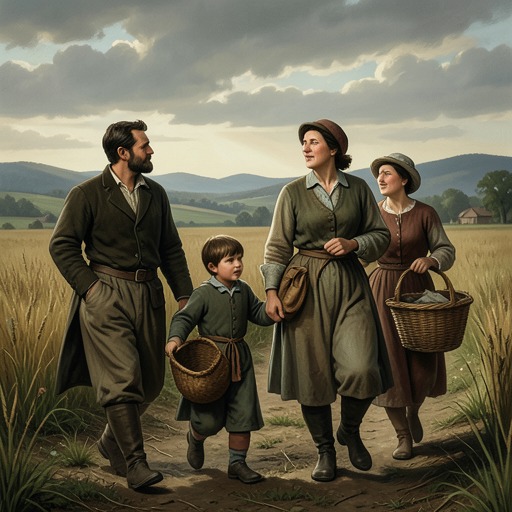
In the brilliant [May](entity:time-recall-time-may-1281a8b8ee63) sun, [Pop Larkin](entity:character-recall-character-pop-larkin-750a8494d231) drives his family through flowering orchards and strawberry fields, handing out ice cream and crisps as if the day were already a celebration. At home, amid the animals and heaps of scrap, he proudly calls the ramshackle farm a paradise.
The family’s cheerful abundance establishes the world that will unsettle the tax official who is about to arrive: work and pleasure mingle freely, money circulates in informal deals, and Pop’s idea of prosperity is inseparable from food, family, and the countryside.
during the drive home in late May
Mariette’s Uncertain Pregnancy
[Ma](entity:character-recall-character-ma-9cb60cf0594d) tells Pop that Mariette is expecting a baby but cannot decide which of two men might be the father. One candidate, Charles, has gone overseas; the other, Harry, works on the railway and is already married. Pop accepts the news with characteristic equanimity and says they will think of something.
The revelation hangs over Mariette’s introduction to the visitor later that afternoon, while her parents’ calm response shows how little their household follows conventional rules. Pop briefly wonders why they named her Mariette, and Ma recalls that the name joined her sympathy for Marie Antoinette with Pop’s dislike of a longer name.
late afternoon in late May
The Tax Inspector Arrives
At the farmyard, Pop discovers [Cedric Charlton](entity:character-recall-character-cedric-charlton-044bfdf9e79d) waiting beside the horsebox with a briefcase and a demand for an income return. Pop insists that no form ever reached them, while [Ma](entity:character-recall-character-ma-9cb60cf0594d) confirms that she has never seen one and walks on with the groceries. The official’s attempt to establish a formal interview immediately meets the family’s genial evasions and distractions.
When Pop notices Charlton staring at Mariette, he introduces them and steers the visitor toward the house rather than letting the tax inquiry proceed. Mariette recognizes that she had spotted him first, and Charlton’s attention shifts from the missing paperwork toward the young horsewoman.
that evening in late May
Dinner Becomes an Interrogation
The Larkins seat Charlton among fish and chips, ice cream, pineapple, jam, tea, and the family’s animals. He tries to ask about Pop’s occupation, children, and income, but every question is absorbed into the commotion of meals, television, kittens, and geese. [Ma](entity:character-recall-character-ma-9cb60cf0594d) corrects his description of Pop as a dealer, and Pop calls himself a farmer.
Charlton estimates Pop’s income at a provisional five hundred pounds after Pop turns the question around and asks about the official’s own safe job. The family’s lavish table and Pop’s claims of poverty make the estimate absurdly uncertain; meanwhile, Mariette’s quiet attention and the disorderly hospitality begin to disarm Charlton.
the evening of Charlton’s first visit
A Nightingale in the Wood
After dinner, Pop sends Mariette and Charlton to the wood to hear the nightingales. She identifies the bird among the evening chorus, and Charlton hears a nightingale consciously for the first time. The natural quiet contrasts sharply with the family’s noisy kitchen and intensifies his sense that the Larkin world offers an experience absent from his office life.
Mariette then tells him she knows he had mistaken her for a well-born young woman he had seen riding at Easter. She insists that she is simply herself, not the niece of Lady Planson-Forbes he had imagined. Her touch and their growing intimacy leave Charlton flustered, while she explains that he will have to sign the tax form himself because Pop cannot write his name.
late that night
The Tax Form Goes into the Fire
Back at the house, Pop takes the tax form away from the dinner table and [Ma](entity:character-recall-character-ma-9cb60cf0594d) uses it with scraps and eggshells to stoke the kitchen fire. Pop celebrates the pleasant weather and the prospect of the strawberry season, more preoccupied with the harvest than with his official obligation.
The destruction of the form turns Pop’s casual evasion into a concrete act, while Charlton’s attraction has already weakened his determination to enforce compliance. The episode captures the book’s central collision between bureaucratic duty and the Larkins’ improvised, hospitable way of life.
the next evening
Kippers and a Missed Bus
Charlton says he must catch the last bus, but learns that the service no longer runs. The family serves another meal, this time kippers, and Pop offers whisky as casually as tea. Mariette arrives freshly perfumed with gardenia, and the family’s invitations, jokes, and attention make it increasingly difficult for Charlton to leave.
Pop proposes that Charlton stay overnight and offers the billiard room; Mariette says she will lend him pyjamas. When Charlton tries again to remember the tax business, the television’s changing glow and the family’s talk of a television programme, peaches, and Sunday dinner pull him back into their orbit.
late evening, the second day of Charlton’s visit
The First Cocktails
Pop mixes a potent Rolls-Royce cocktail from his guide, then asks Charlton to join the family in drinking. Charlton tries to keep the tax question alive, but the drinks, noise, and the Larkins’ uninhibited warmth dissolve his resolve. Mariette sits on his lap, and the gardenia scent and her touch overwhelm his already wavering self-command.
Pop’s cocktails make the official a laughing, affectionate guest rather than a visiting officer. Charlton staggers toward the billiard room with Mariette, loses track of events, and ends up caressing a billiard ball in a pocket; in the fall he breaks the thrush eggs he had brought from the wood. Pop, meanwhile, reflects that Charlton does not yet seem to have what it takes to father Mariette’s baby.
the following morning
Charlton’s Morning After
Charlton wakes with a crushing hangover on the billiard table, wearing Mariette’s silk pyjamas and unable to remember how he got there. [Ma](entity:character-recall-character-ma-9cb60cf0594d) serves breakfast and Pop cheerfully teases him about the previous night, while Mariette recalls his drunken struggle with his trousers and his apparent romance with the billiard ball.
Pop urges him to stay for the weekend and administers a Larkin Special, an alarming concoction that gradually revives him. Charlton remembers the missing tax form, but Ma and Pop redirect the conversation toward the farm, the meadows, and a motorboat. By the time the household invites him to stay, his office and official purpose seem less urgent.
Saturday morning
A New Life in the Country
After the Larkin Special, Charlton begins to feel human again and admits that the morning outdoors has improved him. Mariette describes the bluebells, moon-daisies, and nightingales, and the farmyard’s clamor and the open sky give him a first real taste of Pop’s beloved countryside.
By Saturday night, a deep-freeze is installed and the family prepares a Sunday feast. The change in Charlton is physical and emotional: he is recovering from the cocktail and discovering that country air, food, and Mariette’s company may matter more than the office he left behind.
Sunday morning
Pop Acquires a Rolls-Royce
Pop arrives in a pre-war Rolls-Royce with straw-colored doors and monograms, delighted to show the family its luxurious fittings, flower vases, speaking tube, and contrasting horns. [Ma](entity:character-recall-character-ma-9cb60cf0594d) is dazzled by the car but worries that its appearance will raise the price of fish and chips; she nevertheless insists that they take flowers along whenever they go out.
The car becomes a flamboyant emblem of Pop’s appetite for possessions and his ability to obtain them through deals. The Larkins pile inside for a ride around the yard, where the horns scatter poultry and make the Rolls’ refinement collide comically with the farm’s rough surroundings.
Sunday morning
The Brigadier Needs a Field
[The Brigadier](entity:character-recall-character-the-brigadier-25c0a54da14c) arrives with a problem: a committee dispute has cost the pony gymkhana its venue. Pop immediately offers his meadow, seeing no reason to hesitate, and promises to have the grass cut. The Brigadier is deeply grateful, while Pop thinks of Mariette’s love of jumping and the possibility that this may be one of her last chances to ride before the expected baby.
The offer brings the Larkins into the center of the village event and turns their land into a communal space. It also reveals Pop’s instinctive generosity: he treats his property not merely as an asset but as something to share, even when the committee and its members do not always regard him as their equal.
Sunday at midday
The Sunday Feast
[Ma](entity:character-recall-character-ma-9cb60cf0594d) prepares geese and an overflowing spread beneath the walnut tree, and the Brigadier, who had expected a cold meal at the pub, is drawn into the Larkins’ hospitality. Pop carves generously, Ma keeps adding food, and the family’s frank conversation about the committee and its members makes the Brigadier feel both fed and included.
When the Brigadier announces that the gymkhana will be held in Pop’s meadow, Mariette leaps up to kiss her father and then the Brigadier. She also kisses Charlton, who is overwhelmed by the gesture and by the unsettling thought that the goose he is eating may be the same one that had brushed against him beneath the table. The feast binds the visitors to the family while pushing Charlton’s feelings for Mariette toward a more definite attachment.
Sunday afternoon
A Walk Across the Meadow
After dinner, Mariette carries tea across the garden, and Charlton remains too self-conscious to take the openings she and [Ma](entity:character-recall-character-ma-9cb60cf0594d) create for him to be alone with her. The day grows warm and languid; Pop imagines the coming gymkhana and the Brigadier falls asleep at the table.
At last Mariette takes Charlton’s hand and leads him across the meadow. The scent of hawthorn, clover, and rising grasses overwhelms her, and she runs barefoot; Charlton runs after her, newly alive to her beauty and to the possibility of a life beyond his office routines.
after Sunday, as strawberry season begins
Charlton Takes Sick Leave
Pop and [Ma](entity:character-recall-character-ma-9cb60cf0594d) tell Charlton that he looks unwell and urge him to take advantage of sick leave. Charlton objects that nothing is actually wrong with him, but Pop suggests inventing an ailment, and Mariette’s repeated kisses make the idea of returning to work still less appealing.
Charlton extends his leave and joins the family for the first strawberry-picking day. His official life begins to recede as the Larkins offer him food, company, and a place in the seasonal work that sustains their household.
Monday morning
The First Strawberry Morning
The family rides to [Benacre](entity:location-recall-location-benacre-6e624f4a6171) in the truck, singing as it jolts along, and Pop picks up the tiny Aunt Fan on the way. Charlton, sickened by the motion and the heat, arrives at the field already dreading the day. Mariette reassures him, and he tries picking among the rows while the workers call, joke, and fill their baskets.
When the foreman needs someone to weigh and record the baskets, Pop secures Charlton the job. The shaded tent feels like an office, and Charlton is relieved to sit down and use his trained arithmetic. His first day in the strawberry lark thus begins not as a successful picker but as an unexpected clerk in the very economy he had come to inspect.
Monday morning, during the first day in the field
Mariette’s Jealousy
[Pauline Jackson](entity:character-recall-character-pauline-jackson-139d1061d9ad) visits the weighing tent, flirts with Charlton, and asks for [Ma](entity:character-recall-character-ma-9cb60cf0594d)’s orange lollipop. She tests his shyness and suggests that Mariette is merely another woman who knows him. Charlton’s awkward answers leave the exchange open to misinterpretation, and Mariette arrives just in time to see Pauline departing with a taunting look.
Mariette calls Pauline a tart and reveals a jealousy that Charlton has not previously seen in her. She leaves for the wood to cool off, while he is left wondering what he has done and lacking the confidence to confront the women who later challenge his figures.
Monday, late morning
The Pickers Test Charlton
[Poll Sanders and Lil](entity:character-recall-character-poll-sanders-and-li-78471c73fdae) repeatedly dispute the basket totals Charlton writes down, exploiting his uncertainty and pressuring him to accept their claims. He realizes that he must concentrate if he is to keep the records straight, and the tent becomes more difficult to manage as the heat rises and workers crowd in.
The Larkins bring him food and lollipops, but the work is still a test of his ability to adapt. Charlton’s office skills are useful, yet the field demands sharper judgment than simply trusting the figures other people give him.
Monday afternoon
A Rivalry Turns Violent
In the oppressive heat, the women in the field shed their outer clothes, and Pauline returns to the tent to invite Charlton for a ride on her Vespa and a swim. He is flustered by her advances and has not given her a clear refusal when Poll and Lil arrive asking for money.
A commotion outside reveals Pauline and Mariette fighting, rubbing smashed strawberries into each other’s faces and tearing at their hair. Charlton fears Mariette will be hurt, but Aunt Fan watches the spectacle with delighted enthusiasm. [Ma](entity:character-recall-character-ma-9cb60cf0594d) later instructs everyone not to tell Pop, fearing his anger; Charlton rides home proud of Mariette and newly aware that she has fought over him.
Monday evening
Charlton Rejects the Tax Argument
After the long day, Pop pours Charlton a drink and asks how the work went. Charlton reports that he managed well, and Pop suggests that he take Mariette for a walk to the river. Before leaving, Charlton raises a question about whether seasonal pickers should legally pay tax on their earnings.
Pop argues that taxing the workers would drive them away and destroy the fruit harvest. Charlton accepts the practical force of the argument and goes out with Mariette instead of pressing the matter. The exchange marks a quiet turning point: the official begins to see the human and economic logic behind the informal system he had intended to regulate.
Monday evening
A Private Walk by the River
Charlton and Mariette go out into the evening countryside, with their thoughts on the meadow and the growing intimacy between them. Their affection deepens away from the family’s noisy table, while Pop settles in front of the television after a successful day trading scrap.
The contrast between Pop’s relaxed pleasure and Charlton’s growing emotional commitment shows how completely the official has entered the Larkin world. The relationship is no longer merely a brief enchantment produced by gardenia, drink, and country air.
the following evening
Edith Sees the Gymkhana Field
[Edith Pilchester](entity:character-recall-character-edith-pilchester-9f12069289b3) arrives to discuss the gymkhana and finds Pop’s meadow freshly cut and ready for the event. She calls the preparations ghastly in her habitual fashion but recognizes that Pop has solved the committee’s crisis by making both the competition field and an adjoining car park available.
Her gratitude is personal as well as practical. She remembers Pop’s warmth and the kiss he gave her at a village social, and his effortless generosity makes her feel that the event might still succeed despite the committee’s failures.
that evening
A Doctor’s Visit
Pop finds Dr Leagrave visiting and asks him to examine Charlton, whom the family has been calling ill with lumbago. The doctor presses Charlton’s back and discovers that he has no pain; Charlton admits to himself that the strawberry work has improved his health and that he is enjoying the days in the field.
The doctor recommends avoiding draughts and wet grass, then accepts pork from Pop. Charlton’s invented sickness has become an excuse to remain in the countryside, but he no longer needs to pretend that he is miserable: he has found work, food, and a relationship that he wants to continue.
later that evening
Pop Kisses Edith
Pop drives Edith home in his Rolls-Royce and shows her the monograms, flower vases, and speaking tube. At her cottage, which is cramped and disorderly, she offers him whisky and laments how hard it is to manage without help. Pop listens and advises her about her War Stock, while she encourages him to consider becoming Master of Fox Hounds.
When Pop rises to leave, Edith asks him to stay and he kisses her passionately. She is delighted by the encounter, and Pop returns home thinking that her house is appalling, without realizing how much the kiss has affected her. At home, [Ma](entity:character-recall-character-ma-9cb60cf0594d) takes the story lightly and reminds Pop that he owes her a kiss too; their own intimacy resumes beneath the summer stars.
the day of the pony gymkhana, before dawn
The Gymkhana Begins
Charlton rises at half past four for the event, eats a substantial breakfast, and helps Mariette feed the donkeys. Pop has arranged for the animals to enliven the usual riding competitions, while the committee has rejected his offer of fireworks because they might frighten the ponies.
The preparations place the whole family at the center of the day. Pop has already been working since before dawn, Edith is expected to manage the event, and Mariette is excited to ride. Charlton now belongs naturally among them, sharing both the work and the anticipation.
gymkhana morning
Edith Arrives in Chaos
Edith reaches the meadow hours late in a taxi, burdened with luggage, judging papers, books, food, and pot-eggs that spill around her. She immediately rushes between tents and tasks, trying to impose order while the Brigadier dryly observes that some of the donkeys have been there all night.
Her frantic work illustrates both her devotion to the event and the shortage of people willing to give it their time. Despite her disorganization, the gymkhana is proceeding because Pop and his family have supplied the land, animals, food, and labor.
late gymkhana morning
The Judge Is Forgotten
The committee discovers that Edith has forgotten to meet the London train bringing the invited horse-show judge. A caller complains by telephone, and Pop asks why the judge could not have come by car. The crisis is solved when Pop proposes sending Mariette and Charlton to collect him in the station wagon while they fetch more champagne.
The practical emergency also exposes the blurred boundary between the gymkhana and Pop’s separate plans for a cocktail party. Edith learns that the couple have sent invitations and that Pop ordered champagne, then extracts a promise that he will not use fireworks during the event.
gymkhana midday
Pop Courts a New Buyer
At the beer tent, Pop approaches [Sir George Bluff-Gore](entity:character-recall-character-sir-george-bluff-go-ecacb7c686d3) and bluntly asks when he will sell [Bluff Court](entity:location-recall-location-bluff-court-6b6db79044c7). The estate is too large and expensive to maintain, but Sir George cannot imagine giving it up. Pop argues that the unused mansion should be pulled down and offers to buy it for its salvageable materials.
Sir George is stunned by the proposal, while Pop leaves him to consider it. The exchange introduces the declining rural gentry as a force in the story: an aristocratic property is becoming a burden, and Pop sees value where its owner sees an inheritance that cannot be surrendered.
gymkhana afternoon
Jasmine Bolts with Edith
Pop persuades Edith to ride in the Ladies’ Donkey Derby, where she finds herself surrounded by teenage competitors and perched awkwardly on the hairy donkey Jasmine. Pop tells her to grip with her knees and look straight ahead, but Jasmine remains stubbornly immobile as the other donkeys wander or trot about.
A loudspeaker announcement for a missing child startles Jasmine into bolting. She carries Edith back to the river, where a couple are embracing in the long grass, and a startled soldier tells Edith and Pop to go away and leave them alone. Edith’s mortifying ride becomes one of the day’s defining spectacles and a source of lasting amusement.
eight o’clock on gymkhana day
The Cocktail Party Overflows
Pop’s casual invitations bring fifty or sixty people to the cocktail party, many of them never formally invited. The billiard room fills with smoke, champagne, food, and noise as Pop, [Ma](entity:character-recall-character-ma-9cb60cf0594d), Mariette, Charlton, and Montgomery try to serve everyone. Pop insists that nobody should be turned away, and Ma’s generous table keeps the crowded gathering in motion.
The party makes Pop’s house a meeting place for people across the village’s class divisions. He takes particular care of the timid Miss Barnwells, pressing sandwiches and drinks on them, while the guests’ praise confirms his pleasure in having created an event that feels more like a communal feast than a formal reception.
during the cocktail party
Lady Bluff-Gore’s Proposal
[Lady Rose Bluff-Gore](entity:character-recall-character-lady-rose-bluff-gor-5a4e431966b8) finds Pop and asks about his offer to demolish the family mansion. She has long wished to be rid of [Bluff Court](entity:location-recall-location-bluff-court-6b6db79044c7) and its costly outbuildings, and wonders whether its sale could give her and her husband money and a more comfortable life. Pop understands that she wants to make a private arrangement with him and agrees to inspect the property.
Their conversation opens the possibility that Pop may acquire the estate he had just proposed to dismantle. Lady Rose’s interest suggests that the owner’s household is as trapped by the grand house as Pop had inferred, while his appetite for a deal turns social conversation into practical negotiation.
later during the cocktail party
A Party Kiss and a New Invitation
Edith reminds Pop that he promised another kiss. He obliges, though their encounter is complicated by her formidable teeth, and she thanks him for making the gymkhana and party possible. Then the tall, elegant Angela Snow introduces herself, praises the day, and invites Pop to bring his donkey show to an event at Emhurst Valley.
Angela’s enthusiasm for Pop’s comic ideas and her love of fireworks immediately appeal to him. She offers a new opening for the future, while her arrival at the party helps revive Pop’s abandoned wish to make the evening memorable with fireworks.
late evening on gymkhana day
Mariette and Charlton Announce Their Marriage
As Pop prepares drinks for Angela, Mariette and Charlton try to speak with him. At last Charlton announces that he wants to marry Mariette and that [Ma](entity:character-recall-character-ma-9cb60cf0594d) has said she may do so if Pop agrees. Pop answers at once that he is happy to let them marry.
With the house already full of guests, Pop climbs onto a chair and announces the engagement, asking everyone to raise a glass to the couple. The declaration transforms the relationship that began during a tax visit into a family commitment, and the celebration reaches its climax just as Pop’s secret fireworks begin to explode.
the end of gymkhana night
Fireworks Over the Garden
The elegant Angela helps Pop set off fireworks throughout the house and garden, despite his promise to Edith that there would be none. Roman candles, crackers, a Catherine Wheel, and rockets send the guests running outdoors. [Ma](entity:character-recall-character-ma-9cb60cf0594d) laughs through the chaos, Edith protests that the whole thing is ghastly, and the Miss Barnwells giggle at the noise.
As Pop runs about with a Golden Rain, Charlton finally tells him that he wants to marry Mariette. Pop’s exuberance briefly eclipses the seriousness of the announcement, but he makes it public and raises the toast. A final Roman candle blasts him backward, and Charlton calls out a cribbage phrase as the family and guests roar with laughter.
after the party, late that night
A False Pregnancy and a New One
When the guests have gone, Pop and [Ma](entity:character-recall-character-ma-9cb60cf0594d) eat apple tart in the kitchen and discuss the party. Ma tells Pop that Mariette is not pregnant after all; the suspected pregnancy was a false alarm. Pop is relieved, and the couple turn to the unexpected possibility of a child in their own future.
Ma reveals that she is pregnant, tracing it to an evening in [Bluebell Wood](entity:location-recall-location-bluebell-wood-39360aa465d5) before Charlton arrived. Pop is surprised but pleased, and the two begin talking about names and whether the child might be twins. The earlier uncertainty surrounding Mariette’s pregnancy gives way to a new prospect within Pop and Ma’s own relationship.
that same night
Pop and Ma Consider Marriage
As they discuss [Ma](entity:character-recall-character-ma-9cb60cf0594d)’s pregnancy, Pop suggests that they may have to get married if the situation continues. Ma says she is willing and notes that her rings will have to be cut off again anyway. Their conversation is tender but practical, showing how their long-established partnership has never depended on formal marriage.
When Charlton and Mariette join them, Charlton warns that marriage may not be advantageous for tax purposes and advises them to keep the status quo. Pop accepts the counsel, despite Ma’s objection to the word Charlton nearly uses, and the pair decide not to marry for the present. The advice also reinforces Charlton’s new role as a trusted family adviser rather than a tax enforcer.
near the end of the first story
A Bungalow for the Newlyweds
Charlton worries aloud that Pop’s tax affairs may eventually catch up with him, especially after acquiring the Rolls-Royce. Pop dismisses the concern and proposes a more immediate plan: when he demolishes the Bluff-Gore mansion, he will use the best materials to build Mariette and Charlton a bungalow in the meadow near the bluebell wood.
Mariette embraces her father and the proposed home, and Charlton recognizes that there is little left to argue against. Pop’s offer turns his demolition scheme into a promise of a shared future for the young couple, while the family’s summer world seems to have expanded rather than broken apart.
the final evening of the first story
The First Novel Ends with Nightingales
The family gathers at the kitchen door as summer rain begins, and Pop listens to the nightingales. Charlton reflects on the season’s passage from spring into full summer, while Pop regards the rain as a blessing for the cherries, plums, and apples.
The closing image returns the story to the countryside that first captivated Charlton and that Pop calls his paradise. The nightingales bind the end to the first visit, now heard by a man who has become part of the Larkin family’s life.
about a year later, in July
Oscar Joins the Family
Nearly a year after Charlton’s first visit, [Ma](entity:character-recall-character-ma-9cb60cf0594d) and Pop’s seventh child, Oscar, lies in his pram in the kitchen. Pop greets Charlton with his customary blow on the back, and the household moves through breakfast amid crying baby, frying sausages, bacon, mushrooms, and heavy rain. Mariette is absent from the table, and Ma says she is feeling peaky.
The scene establishes the family’s new circumstances: Mariette is married to Charlton, the two live within the Larkin orbit, and the household has grown again. Pop suspects that Mariette may be pregnant, but Ma says only that the weather has been getting her down and that she needs a holiday.
a rainy July breakfast
France Appears in The Times
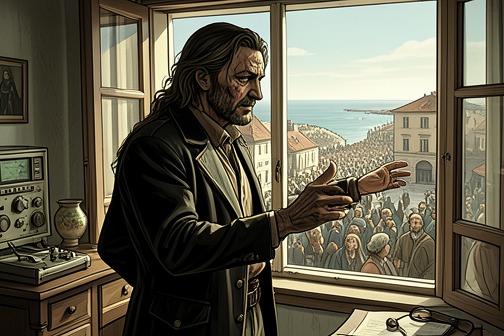
While eating breakfast, Charlton points to a picture of [St Pierre le Port](entity:location-recall-location-st-pierre-le-port-3157ae532d28) in [The Times](entity:organization-recall-organization-the-times-e4ce7e79155a) and remembers the summers he spent there as a boy with his aunt and uncle. He describes the Atlantic coast, the broad tidal sands, and the little train that made [France](entity:location-recall-location-france-f5cafc8a8ad4) vivid to him. Pop is startled to learn that Charlton travelled abroad as a child, and [Ma](entity:character-recall-character-ma-9cb60cf0594d) listens as he recalls the warmth and food of [Brittany](entity:location-recall-location-brittany-477fc442f207).
The recollection catches Ma’s imagination. She says she wants to feel the sun on her chest again, and Charlton’s memories turn a dull, wet morning into the prospect of a family holiday. Pop, initially bewildered, watches the others become excited and begins to consider the idea.
later that July breakfast
The Family Chooses France
[Ma](entity:character-recall-character-ma-9cb60cf0594d) says plainly that she would like to go to [France](entity:location-recall-location-france-f5cafc8a8ad4) for a holiday, and Charlton welcomes the idea. Mariette comes downstairs and is delighted when she learns that the family may travel together; the prospect of sunshine excites both women. Pop asks whether the French really eat frogs and snails, then laughs as Charlton explains that the dishes are delicious.
Charlton offers to teach the family a few French phrases, and Pop eagerly repeats greetings and farewells, proud of his developing accent. He proposes travelling in the Rolls-Royce, and Charlton undertakes to arrange the hotel details and costs in advance. A family holiday shifts from daydream to plan, with Pop’s enthusiasm growing as quickly as his new French vocabulary.
later that morning
Passports and the Family’s Status
Charlton points out that passports will be complicated because Pop and [Ma](entity:character-recall-character-ma-9cb60cf0594d) are unmarried. He suggests putting the children on Pop’s passport and having Ma travel under her maiden name; Ma remembers that she is Flo Parker. Pop is unsettled by the formalities but prefers to leave the arrangements to Charlton.
The discussion exposes the gap between the Larkins’ lived family bonds and official categories. Charlton’s experience with forms and practical arrangements has become indispensable, while Pop regards bureaucracy as something to be handled efficiently and, if possible, kept at a distance.
later that morning
Pop Invites the Brigadier
On his way to a business appointment, Pop encounters the Brigadier walking in the rain with a shopping bag. Pop greets him in French and says the family is going to [Brittany](entity:location-recall-location-brittany-477fc442f207); when the Brigadier wonders about the cost, Pop insists that the family’s wishes matter more than the expense.
Pop invites the Brigadier to join them and offers him a place in the Rolls-Royce, but the Brigadier declines, preferring to walk to the shop for cheese. He is left thinking of the food and sunshine he will miss, while Pop drives away in high spirits, convinced that the whole family will benefit from the journey.
the last day of August, early evening
A Stormy Arrival in Brittany
Pop drives the family’s Rolls-Royce to the [Hôtel Beau Rivage](entity:location-recall-location-h-tel-beau-rivage-cc9799339667) in a violent Atlantic gale. Rain and spray batter the harbor, and the hotel looks smaller and shabbier than Charlton remembers from childhood. The familiar place has not survived unchanged in his memory, and the first sight of it leaves him dismayed.
The family struggles through the storm with children and luggage, while Pop arrives soaked and Charlton takes charge at reception in French. Their holiday has begun not with the imagined warmth of [Brittany](entity:location-recall-location-brittany-477fc442f207) but with wind, darkness, and a difficult confrontation with the present reality of the place.
that evening at the Hôtel Beau Rivage
The Hotel Forms and the Price of Tea
The hotel clerk questions the family’s passports and luggage, then objects that one of the children is so young. [Ma](entity:character-recall-character-ma-9cb60cf0594d) answers that Oscar has only just been born and asks for tea for everyone. The clerk’s formal manner and the family’s directness create an immediate clash, but Charlton smooths the exchange by translating and completing the forms.
When the tea arrives with a bill exceeding two pounds, Ma and Pop are astonished. Charlton tries to explain the cost in francs and to defend the expense, but Ma is more shocked by the hot milk than by the price. The episode punctures their expectation that [France](entity:location-recall-location-france-f5cafc8a8ad4) will be cheap and effortless, establishing the practical frictions that will shape the holiday.
later that evening
No Television in the Hotel
While Charlton struggles with ten registration forms in the dim hotel vestibule, [Ma](entity:character-recall-character-ma-9cb60cf0594d) asks whether the hotel has television. The answer is no, and Pop is appalled. The family turns instead to a portable radio, which Primrose switches on loudly enough to startle Oscar and provoke the clerk into ringing the desk bell.
Pop asks whether there is a bar, but Ma assigns him the baby and says Oscar needs changing. A thunderclap plunges the lobby into darkness, and the family’s unfamiliar surroundings become even more chaotic. Their dependence on familiar comforts, from television to drinks and tea, collides with the storm-battered hotel and its rigid routines.
later that evening, during the storm
Ma Breaks the Hotel Chair
As the family prepares to go upstairs, [Ma](entity:character-recall-character-ma-9cb60cf0594d) discovers that the wicker chair has trapped her. Pop and Charlton pull at her while she laughs uncontrollably, and the hotel clerk watches in alarm. Their efforts finally wrench Ma upright, but the chair is crushed flat behind her.
The clerk protests in French, unable to make himself understood in the commotion. Pop strides to the desk and launches into a jumble of the French phrases Charlton taught him, adding nonsense and a comic approximation of English. He is proud of his accent, and Charlton assures him that it is perfect. The family then heads upstairs, carrying its own brand of disorder into the hotel.